
If you’re reading this, you’ve probably noticed how fast the job-market in India is changing. Maybe you’re finishing school or college and wondering what course will actually help you land a good job. Or perhaps you’re already working and thinking of switching careers or up-skilling. In either case, looking at in-demand courses India 2025 is a smart move — these are the programmes that many employers will be looking for, and many students will be enrolling in.
Many students today are realizing that traditional degrees alone no longer guarantee employment. The market has become skill-driven, and companies are actively hiring candidates with specialized training in fast-growing technologies. That’s why it’s important to look beyond general education and explore focused learning paths that align with where industries are heading.
Let’s apply the APP formula (Audience, Problem, Promise):
- Audience: You — a student, fresher, or someone wanting to update their skills.
- Problem: Unsure which course to pick, because many look good on paper but may not lead to jobs.
- Promise: By reading this article, you’ll get a clear understanding of the top in-demand courses India 2025 (especially Data Science, AI, FinTech), what they involve, their costs, what jobs you can expect — so you can choose confidently.
By the end of this article you’ll know what the term “in-demand courses India 2025” really means, how to check eligibility, approximate fees, what you’ll learn, where you can study, and what kind of jobs & salaries follow. Let’s get started.
India’s youth have a massive opportunity right now. With the government promoting “Digital India” and private sectors expanding automation and analytics, the need for skilled professionals is skyrocketing. So, choosing one of these in-demand courses India 2025 could be your best step toward a secure and rewarding career.
What are “in-demand courses India 2025”?
“In-demand courses” are educational programs that are currently most valued by employers. They give students and professionals the skills that companies need in areas where there’s a shortage of trained people.
Unlike older academic programs that stay static for years, these new-age courses evolve rapidly with technological changes. For instance, an AI course launched two years ago might already have an updated module on generative AI or automation tools. That means you’re not just learning theory — you’re learning skills that adapt to real-world shifts.
In 2025, courses related to Data Science, Artificial Intelligence, Cybersecurity, Cloud Computing, and FinTech are leading the list. These industries are expanding fast as more companies move toward automation, digital payments, and data-driven decision-making.
When you pursue one of these courses, you’re learning skills that align with market trends—meaning your chances of employability and career growth are much higher than average.
The real value of these programs lies in how they combine technical knowledge with business application. A Data Science course, for example, doesn’t just teach coding; it helps you understand how to make business decisions from data. Similarly, FinTech courses teach not only financial modeling but also how technology reshapes banking, payments, and investments.
Eligibility Criteria: Who can join these courses?
Eligibility depends on whether you’re enrolling in a full-time degree program or a short-term certification course. Here’s a quick guide:
Some institutes also consider aptitude tests or interviews to understand whether a candidate has the logical thinking and analytical mindset required for such technical fields. Don’t worry if you lack prior experience — most beginner courses start with the fundamentals and gradually introduce complex topics. What matters is your curiosity and persistence to keep learning.
For Degree Programs (Undergraduate and Postgraduate)
- Students must have completed 10+2 (or equivalent) with relevant subjects like Physics, Chemistry, and Mathematics.
- For postgraduate courses, a bachelor’s degree in engineering, mathematics, computer science, or a related field is required.
- Many institutions also conduct entrance exams like JEE, GATE, or their own aptitude tests.
For Certificate or Online Courses
- Most programs accept candidates who have completed at least 12th standard or are graduates in any stream.
- Basic computer knowledge and analytical skills are useful but not mandatory.
- Working professionals from non-technical backgrounds can also join these programs to upskill or switch careers.
In short, eligibility is flexible. Whether you’re a student or a professional, you can start learning if you’re committed to developing new skills.
For working professionals, these courses are an excellent way to stay relevant in the job market. Many people from non-technical backgrounds — like marketing, finance, and even design — are successfully switching careers after completing short-term online programs. This flexibility is one reason these in-demand courses India 2025 are becoming popular across all age groups.
For certificate/online courses (short-term)
- Usually 12th pass or graduation is sufficient. Some courses accept students from non-science streams as well. Universal AI+1
- Basic maths, logical reasoning, and sometimes basic programming knowledge may help.
- Often there is no strict age limit; working professionals can enrol.
- For in-demand courses India 2025, the key is your willingness to learn and showcase projects — institutes will often look at portfolio or course-completion projects.
Things to check
- Does the course require prior programming / maths knowledge? If so, are you comfortable?
- What stream did you come from (Science, Commerce, Arts) – some courses allow any stream; some require science.
- Working professionals: Many short-term courses allow you to upskill while working.
If you check these eligibility criteria ahead, you’ll avoid surprises when you apply.
Duration and Fees

Before you plan your enrollment, it’s smart to understand that course duration and cost often reflect the depth and placement value of the program. Short-term certificates focus on fast skill-building, while longer diploma or degree programs provide a more comprehensive understanding of both theory and practice.
The duration and cost of these in-demand courses in India 2025 depend on the format you choose—online, offline, diploma, or full degree.
Duration
- Short-term certifications: 3 to 12 months
- Diploma or postgraduate certificates: 6 months to 2 years
- Bachelor’s degree: 3 to 4 years
- Master’s degree: 1 to 2 years
Fees
- Online certificates: ₹40,000 to ₹1,50,000
- Diplomas: ₹60,000 to ₹2,00,000
- Full-time degrees: ₹3,00,000 to ₹10,00,000 or more, depending on the institute
When choosing a course, balance the cost with expected job opportunities. Expensive doesn’t always mean better—focus on course content, industry exposure, and placement support.
Some platforms also offer “learn now, pay later” options or scholarships for deserving candidates, making these courses more accessible. Always compare features — such as mentorship, project support, and placement guidance — rather than just picking the cheapest option. Remember, the goal isn’t just to finish a course but to build a career-ready skill set.
Syllabus / Topics Covered
Though the syllabus varies by course and specialization, most in-demand courses in India 2025 share similar core subjects. Here’s what you’ll commonly learn:
Core Subjects
- Programming: Python, R, or SQL
- Mathematics & Statistics: Probability, Linear Algebra, Statistical Analysis
- Data Science: Data cleaning, data visualization, Big Data tools
- Machine Learning & AI: Supervised and unsupervised learning, model development
- Deep Learning: Neural networks, computer vision, natural language processing
- FinTech Fundamentals: Blockchain, digital payments, risk analysis, financial modeling
- Tools: Tableau, Power BI, Hadoop, TensorFlow, and cloud-based platforms
- Projects: Hands-on assignments, real-world datasets, and internships
Modern employers value practical experience, so make sure your course includes live projects or capstone work that helps you apply what you learn.
The curriculum in these in-demand courses India 2025 is designed not only to teach hard skills but also soft skills like communication, problem-solving, and teamwork. In most industries, employers look for individuals who can present their findings, collaborate with teams, and think critically about business impact — not just code or crunch data.
Moreover, top programs integrate case studies from Indian and global companies. For example, a FinTech course might include an analysis of how UPI transformed digital payments in India, while an AI module could explore real-world examples like chatbots in customer service. Such contextual learning ensures you’re not just memorizing theories but seeing how technology actually shapes industries.
Top Institutes Offering These Courses
If you want to pursue these in-demand courses, you have several great options in India. Many reputed institutions now offer both classroom and online formats.
Top Universities and Institutes
- IITs and IIITs – Offer degree and certificate programs in Data Science, AI, and Machine Learning.
- IIMs – Offer specialized courses in FinTech and Business Analytics.
- Private Universities – Such as Amity, Manipal, and SRM offering B.Tech and M.Tech in AI & Data Science.
- Online Platforms – Platforms like UpGrad, Simplilearn, Coursera, and edX partner with global universities for affordable online certifications.
Before you decide, take time to read student testimonials and placement records. Many reputed institutes showcase alumni success stories that give a clear picture of what to expect after completion. You can even connect with past students on LinkedIn to understand whether the program delivered real job value.
When selecting an institute, check for faculty quality, placement records, course updates, and whether the program offers real-world industry exposure.
When comparing institutes, pay attention to how current their syllabus is. Technology moves fast — a course that was cutting-edge in 2022 may already be outdated in 2025. Pick institutes that revise their material frequently and bring in instructors from active industry backgrounds, not just academics.
Career Opportunities After Completing the Course
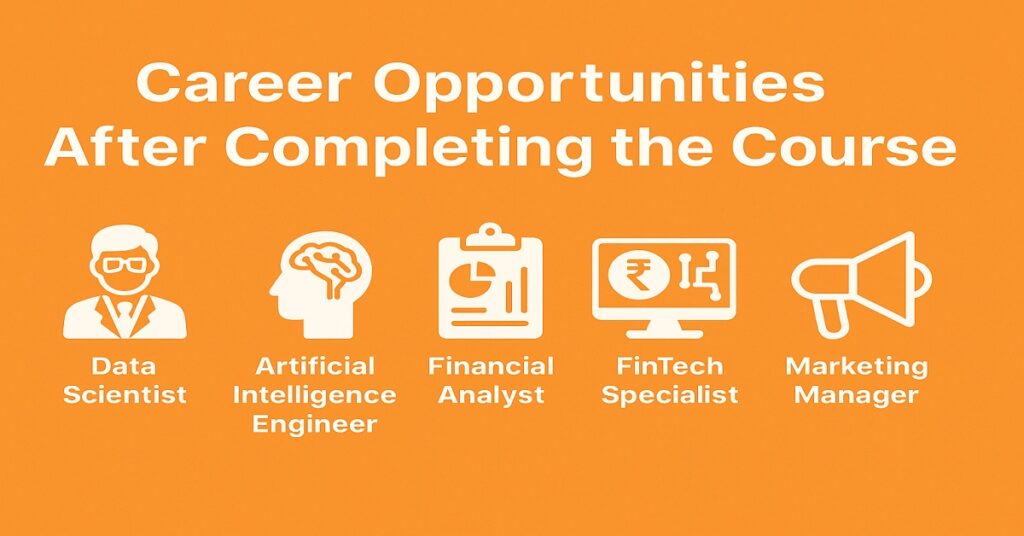
Once you finish one of these in-demand courses in India 2025, you’ll have multiple career paths open to you. Companies across all sectors are hiring professionals with these skills.
Beyond traditional roles like Data Analyst or AI Engineer, many emerging jobs are being created around these technologies. Roles such as Prompt Engineer, AI Ethics Specialist, and Blockchain Consultant are becoming highly sought-after as industries expand their digital transformation. These are areas where skill demand is high but competition is still low, giving early learners a strong advantage.
Career Options
- Data Analyst
- Data Scientist
- Machine Learning Engineer
- AI Engineer
- FinTech Analyst
- Risk and Compliance Officer
- Cloud Solutions Architect
- Business Intelligence Analyst
Industries hiring for these roles include IT, finance, e-commerce, manufacturing, healthcare, and even government organizations that are adopting digital transformation.
These courses not only improve your employability but also make it easier to work with global clients and international companies that rely on modern digital systems.
The beauty of these courses is their versatility. A professional with AI knowledge can work in sectors as varied as healthcare, logistics, or entertainment. Similarly, FinTech experts can find roles in banks, startups, or global financial corporations. The cross-industry applicability of these in-demand courses India 2025 ensures your career options remain open, even as technologies evolve.
Salary Scope
Salary in these fields depends on your role, experience, and skill level, but overall, they are among the most rewarding careers in India today.
The salary structure also depends on the type of company you join. Product-based companies and global startups often offer higher packages compared to traditional service firms because they value innovation and data-driven expertise. If you can demonstrate strong project work or internships during your course, your starting salary can easily jump above the industry average.
Average Salary Range
- Freshers (0–2 years): ₹4–8 LPA
- Mid-level professionals (3–5 years): ₹10–18 LPA
- Senior professionals (6+ years): ₹20–40 LPA or more
Salaries also vary by city. Metro areas like Bengaluru, Mumbai, and Hyderabad offer higher pay packages due to the concentration of tech and finance companies.
If you build a strong portfolio and continuously upgrade your skills, you can move into leadership or specialist roles that offer significantly higher compensation.
Apart from base salary, professionals in these domains often enjoy additional benefits — performance bonuses, flexible work setups, and opportunities for international exposure. Many global firms in India now allow remote work for roles like AI Developer or Data Scientist, giving you access to international clients without leaving home.
Recommended For You
- Best Free Online Courses for Students & Job Seekers in 2025
- 10 Advantages of Online Classes in 2025
- English Speaking Course Online Free – Learn Fluent English in 2025
- High Salary Courses after 12th Science Biology in India (2025 Guide)
- High Salary Courses after 12th Science without NEET – Top Career Options 2025
FAQs
Conclusion: Should You Take These Courses?
If you want a career that’s future-proof and globally relevant, choosing one of the in-demand courses India 2025 is a smart investment. These programs prepare you for industries that are rapidly expanding and constantly looking for skilled professionals.
In-demand courses aren’t just about chasing trends; they’re about preparing yourself for a world where adaptability and skill mastery matter more than titles. By taking a forward-looking approach, you future-proof your career and stay ahead of peers who rely solely on outdated academic models.
They are ideal for:
- Students looking for high-paying and stable jobs
- Working professionals seeking career growth or transition
- Individuals interested in technology, finance, or data
The best approach is to choose a course that matches your interests and commit to continuous learning. With the right mix of knowledge, practice, and curiosity, you can build a career that grows with the future economy.
Remember, the right course is not just one that’s popular — it’s the one that aligns with your strengths, interests, and career vision. Take time to research, talk to mentors, and pick a path that excites you. Your learning journey doesn’t end with the certificate; it begins there. The skills you gain today could be the foundation of tomorrow’s success story.
Share This Post and Help Others Choose the Right Career Path
If this article helped you understand the top in-demand courses in India for 2025, imagine how useful it could be for your friends, classmates, or colleagues who are also unsure about what to study next. Sharing this post can help them discover the right course, make smarter career choices, and stay prepared for the future job market. Click the share button and spread the knowledge — you might be the reason someone chooses the right path for their dream career.
Related posts:
 Best Free Online Courses for Students & Job Seekers in 2025
 10 Advantages of Online Classes in 2025
 Google Free Certification Courses 2025 – Learn Skills for Free with Google Certificates
 10 Best Free Python Courses with Certificate in 2025 (Learn & Get Certified)
 7 Best Free Microsoft Excel Certification Courses Online in 2025
 Government Free Online Courses with Certificates: Your Ultimate Guide to Skill Development in India