

Students today are confused with the huge number of courses in MBA, specializations, colleges, and career paths. Everyone says MBA is important, but most people don’t explain which course to choose or how it truly helps.
This article aims to address that confusion by explaining every major MBA course in simple words.
It promises to give you practical guidance on eligibility, fees, syllabus, institutes, salary, and career options.
And by the end, you will feel prepared and confident to choose the right MBA course that fits your goals, whether you want a corporate job, start your own business, or switch your career path.
Let’s start by understanding what the MBA course actually means.
Many students also choose MBA because it works like a foundation for multiple career paths. Even if someone is unsure about their long-term plan, an MBA gives them enough flexibility to explore roles in marketing, finance, HR, analytics, operations, consulting and more.
This makes it a safe and practical choice in a competitive job market. Another reason the demand for courses in MBA is rising is because companies now look for people who understand both business and technology.
Whether you aim to work in a startup, a multinational company or even government sectors, the knowledge from an MBA helps you make confident decisions and adapt to constant changes in the industry.
Check this Latest Article: Courses in BTech: Complete Guide to Eligibility, Fees, Syllabus & Jobs
What Is an MBA?
MBA stands for Master of Business Administration. It is a two-year postgraduate program that teaches how companies work, how businesses grow, and how leaders make decisions.
When students search for courses in MBA, they usually mean MBA specializations. These are focused areas like marketing, finance, HR, IT, business analytics, etc.
Think of MBA like a tree.
The main degree is the trunk.
The courses in MBA (specializations) are the branches.
Students pick a specialization based on interest, skills, and career goals.
What makes MBA even more valuable is how it develops your problem-solving and leadership abilities. Beyond classroom learning, students participate in group discussions, presentations, case studies and real business simulations.
These experiences teach you how to work under pressure, how to think strategically and how to communicate your ideas clearly. This is why employers prefer candidates who have completed courses in MBA, because they gain practical skills that go beyond theory.
Eligibility Criteria for MBA
Most colleges follow similar rules. You can apply if you meet these:
Education
• A bachelor’s degree in any stream (BA, BCom, BSc, BBA, BTech, etc.)
• Minimum 50 percent marks (45 percent for reserved categories in many institutes)
Entrance Exams
Some colleges require exams like:
CAT
MAT
CMAT
XAT
TS ICET / AP ICET
GMAT (for premium institutes)
Several private universities also offer direct admission based on merit.
In some colleges, students with strong extracurricular achievements, internships or prior entrepreneurial attempts are also preferred during the admission process. This is because they bring practical exposure that enriches classroom discussions.
Candidates from engineering, commerce, arts and even medical backgrounds apply for different courses in MBA because the eligibility rules are flexible. Colleges mainly look for students who can manage academic workload and show interest in business-related subjects.
Age Limit
There is no upper age limit for MBA.
Work Experience
Not compulsory, but preferred for Executive MBA.
You Might Also Like: Most Demanding Courses in Future: Complete Guide for Students & Job Seekers
Duration and Fees of MBA
Duration
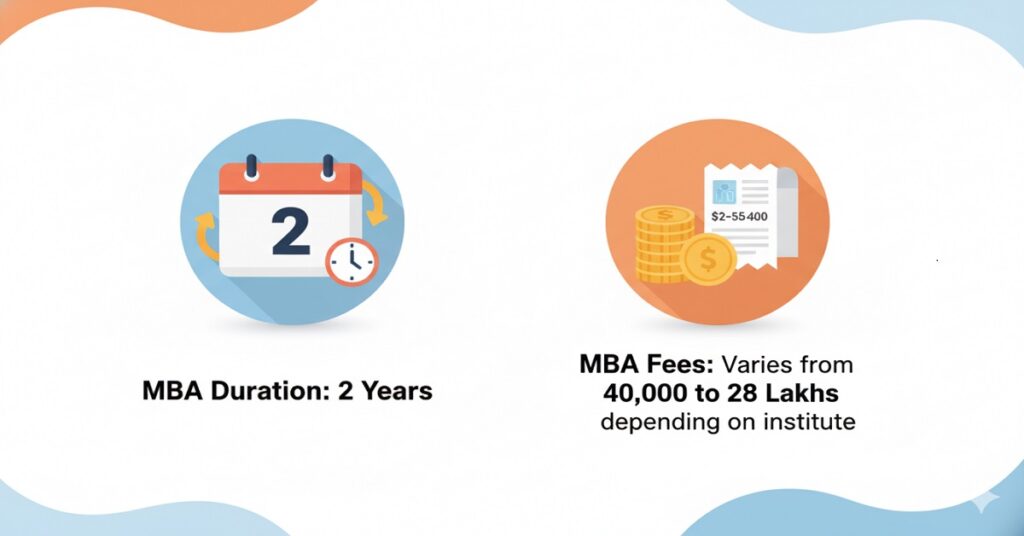
The standard MBA program is 2 years divided into 4 semesters.
Some institutes offer:
• 1 year Executive MBA
• Online MBA (flexible duration)
• Distance MBA
Fee Range
MBA fees vary widely across India.
A few examples:
• Government colleges: INR 40,000 to 2 lakh
• Private colleges: INR 2 lakh to 8 lakh
• Premium institutes (IIMs, XLRI, ISB): INR 15 lakh to 28 lakh
• Online MBA (Coursera, UpGrad, Manipal Online): INR 30,000 to 1.5 lakh
The choice depends on your budget, placement record, and long-term goals.
Another factor that affects the cost is the location of the institute. Colleges in metro cities such as Mumbai, Delhi and Bangalore usually have higher fees compared to institutes in smaller towns. However, placements in metro-based institutes tend to be stronger due to better industry connections.
Students today are also choosing online courses in MBA because they allow flexible learning at a much lower fee. Many online programs also include live classes, projects and recorded sessions, making them suitable for working professionals who want to upgrade their qualifications without quitting their jobs.
Courses in MBA (Specializations Explained Simply)
This is where most students get confused. Here is a simple breakdown of the most popular courses in MBA.
1. MBA in Marketing
Focuses on sales, branding, advertising, digital marketing.
Best for: Students who enjoy communication, creativity, or dealing with people.
2. MBA in Finance
Covers investments, banking, accounting, financial planning.
Best for: Students who like numbers, analysis, and financial markets.
3. MBA in Human Resource Management (HR)
Trains you in hiring, employee management, payroll, training.
Best for: Students with strong communication and people management skills.
4. MBA in Business Analytics
Teaches data analysis, forecasting, data tools like Python, Excel, Tableau.
Best for: Students who like data, logic, and problem solving.
5. MBA in IT / Systems Management
Focuses on technology management, software projects, IT consulting.
Best for: BTech/BCA students or those interested in tech leadership roles.
6. MBA in Operations Management
Covers supply chain, logistics, production planning.
Best for: Students who like planning, systems, and process improvement.
7. MBA in International Business
Study of global trade, import/export, international markets.
Best for: Students who want global careers.
8. MBA in Healthcare Management
Growing demand after COVID-19.
Best for: Students aiming for hospital administration jobs.
9. MBA in Entrepreneurship
Focus on business planning, finance, leadership, innovation.
Best for: Students who dream of running their own business.
These are the most searched courses in MBA because they offer strong career prospects and a wide range of job roles.
Syllabus of MBA (General Overview)
While the syllabus varies slightly between colleges, most MBA programs cover these subjects:
Core Subjects
• Marketing Management
• Financial Management
• Human Resource Management
• Business Statistics
• Micro and Macro Economics
• Accounting
• Business Law
• Operations
• Strategic Management
Specialization Subjects
Each specialization has its own set of advanced subjects. For example:
Marketing: Consumer Behaviour, Sales Management
Finance: Portfolio Management, Banking
HR: Organizational Behaviour, Performance Appraisal
Analytics: Python, Machine Learning Basics
Operations: Logistics, Supply Chain, Quality Management
Projects and Internships
MBA programs also include:
• Summer internships
• Case studies
• Industry visits
• Group projects
• Business presentations
These help students build confidence and gain practical exposure.
While every college has its own teaching style, the core idea of all courses in MBA is to build analytical thinking and decision-making skills. Many institutes now include digital tools in their syllabus such as Excel for finance, Canva for marketing, HRMS software for HR and Python for analytics.
These additions help students work confidently in real company environments. Some colleges also offer elective subjects that let students explore new-age careers like e-commerce management, retail analytics, social media strategy and startup incubation.
Keep Reading: Why “in-demand courses India 2025” matter, and who should take them
Top Institutes Offering MBA in India
Premium Institutes
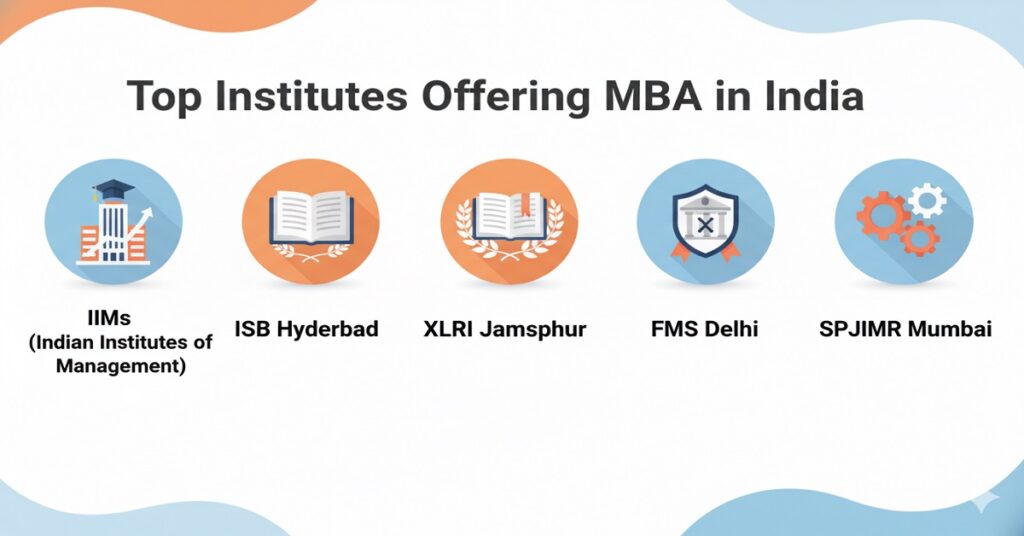
• Indian Institutes of Management (IIMs)
• Indian School of Business (ISB)
• XLRI Jamshedpur
• SPJIMR Mumbai
• FMS Delhi
• NMIMS Mumbai
• Symbiosis (SIU)
Affordable and Good Universities
• Delhi University
• Christ University Bangalore
• Amity University
• Jain University
• ICFAI
• Lovely Professional University
• Manipal University
Best Online MBA Platforms
• UpGrad
• Coursera
• Amity Online
• Manipal Online
• IGNOU (Distance MBA)
These offer flexibility for working professionals who want to upgrade skills without leaving their job.
Students should always compare institutes based on faculty experience, placement history, internships offered, industry collaborations and alumni support. A college with active industry partnerships usually provides better internship opportunities and live projects, which significantly improves learning.
Those considering online courses in MBA should check whether the program includes mentor support, placement assistance and certification accepted by leading companies. Researching these details beforehand helps you avoid choosing a college that doesn’t match your career goals.
Career Opportunities After MBA
This is the most important reason students search for courses in MBA. MBA graduates can work in almost every industry because businesses of all sizes need skilled managers.
Here are popular job roles:
Marketing Careers
• Marketing Manager
• Sales Manager
• Digital Marketing Specialist
• Brand Manager
Finance Careers
• Financial Analyst
• Investment Banker
• Accountant
• Banking Officer
HR Careers
• HR Manager
• Recruiter
• Training Manager
Business Analytics Careers
• Data Analyst
• Business Analyst
• Research Analyst
Operations Careers
• Supply Chain Manager
• Logistics Manager
• Operations Executive
IT Management Careers
• Project Manager
• IT Consultant
• Product Manager
Entrepreneurship
Many students start their own companies after gaining business knowledge.
Apart from traditional jobs, MBA graduates can also explore growing fields such as business intelligence, digital business, sustainability management, product strategy, and supply chain automation. Many startups prefer hiring MBA graduates for roles that require quick problem-solving and multitasking.
Students who complete specialized courses in MBA, such as analytics or international business, often get opportunities in global companies with higher exposure. With remote work becoming more common, MBA graduates can now work for international firms right from India, opening a larger employment market.
Explore Next: Best Free Online Courses for Students & Job Seekers in 2025
Salary Scope After MBA
Salary depends on your college, specialization, skills, and job role.
Average Salary for Freshers
• INR 3 lakh to 8 lakh per year in regular colleges
• INR 15 lakh to 30 lakh per year from IIMs and top institutes
Experienced Professionals
• Mid-level roles: 12 lakh to 25 lakh
• Senior roles (10+ years): 25 lakh to 50 lakh or more
Specializations like MBA in Business Analytics, Finance and Marketing usually offer higher starting salaries.
Salaries also depend on the specialization chosen. For example, finance and analytics roles generally offer higher pay due to the technical and analytical nature of the work. Meanwhile, marketing and HR roles provide faster career growth once you gain experience.
Students who take courses in MBA from top institutes usually receive better salary packages because companies trust the training quality and industry exposure offered there. Certifications, internships and additional online courses can further increase your earning potential over time.
FAQs
Many students also ask whether doing internships during their MBA is important. The answer is yes. Internships give you hands-on experience that employers value highly during placements. Another common doubt is whether students from non-commerce backgrounds can understand MBA subjects. The truth is, most MBA subjects start from basics, so students from arts, science or engineering can learn comfortably.
Colleges also conduct foundation classes for beginners. Finally, a question that appears often is whether online courses in MBA are respected by companies. Good online programs from recognized universities carry equal value, especially when combined with strong practical skills and certifications.
Conclusion
Choosing the right courses in MBA can shape your entire career. Whether you want a high-paying corporate job, a management role, or the skills to start your own company, MBA offers a clear path.
If you understand your interests and pick the specialization that aligns with your strengths, MBA can open doors to countless opportunities. It is suitable for students, working professionals, fresh graduates and anyone who wants to grow in the business world.
This guide was created to help you understand everything in one place so you can make a confident decision without confusion.
In a world where industries change quickly, having business knowledge gives you an advantage in almost any career. MBA helps you understand how companies operate, how teams function and how decisions impact growth. Whether you plan to work in corporate offices, run your own business or join a startup, the skills you learn through courses in MBA remain useful for life.
By choosing the right specialization and investing in consistent learning, you can build a stable and rewarding career. This is why students across India continue to see MBA as a smart long-term investment for their future.
Share This With Others
If this guide helped you understand the different courses in MBA and made your decision a little easier, consider sharing it with friends or classmates who may also be searching for the right direction. Many students feel confused about MBA options, fees, career scope and specializations, and a simple share can give them the clarity they’ve been looking for. You never know how much difference one helpful resource can make for someone else.
Sharing this post also supports our effort to create clear, practical and student-focused content. The more people this information reaches, the more young learners can make confident decisions about their future. If you found value in this article, pass it along in your WhatsApp groups, study circles or social media so others can benefit too.
Related posts:
 Courses in BTech: Complete Guide to Eligibility, Fees, Syllabus & Jobs
 Most Demanding Courses in Future: Complete Guide for Students & Job Seekers
 Why “in-demand courses India 2025” matter, and who should take them
 Best Free Online Courses for Students & Job Seekers in 2025
 7 Best Free Microsoft Excel Certification Courses Online in 2025
 Government Free Online Courses with Certificates: Your Ultimate Guide to Skill Development in India